


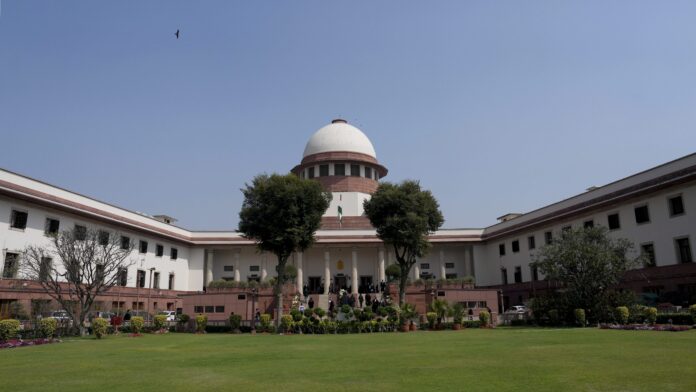

The Supreme Court of India has expressed concern over a concerning trend wherein judges issue numerous judicial orders just before their retirement. Chief Justice of India (CJI) Surya Kant likened this behavior to a cricket player “hitting sixes in the final overs” of a match during a recent hearing.
This observation emerged while the bench, including Justices Joymalya Bagchi and Vipul M. Pancholi, considered a case filed by a Principal District and Sessions Judge from Madhya Pradesh. The judge challenged his suspension, which occurred merely ten days prior to his planned retirement.
“It is an unfortunate trend. There is a growing tendency of judges passing so many orders just before retirement,” Chief Justice Surya Kant remarked during the proceedings, emphasizing the need for judicial restraint.
The CJI’s metaphor highlighted the potential for the issuance of orders motivated by impending retirement rather than the merits of the cases themselves. “Petitioner, just before retirement, started hitting sixes. I do not want to elaborate further,” he observed, underscoring the bench’s disapproval of the phenomenon.
The case in question involved a judicial officer, scheduled to retire on November 30, who had been suspended from his duties on November 19 following a decision by the Madhya Pradesh High Court. His suspension stemmed from two judicial orders he passed shortly before his retirement.
Senior advocate Vipin Sanghi, representing the petitioner, argued for the judicial officer, noting his exemplary service record and consistent high ratings in his Annual Confidential Reports (ACRs). He asserted that disciplinary actions should not penalize a judicial officer merely for executing their judicial duties.
“How can an officer be suspended for judicial orders which are appealable and can be corrected by higher courts?” Sanghi asked rhetorically, challenging the reasoning behind the suspension.
The Supreme Court, in its deliberations, acknowledged that disciplinary actions generally do not arise out of judicial errors. “He cannot be suspended for this. But what if the orders are palpably dishonest?” queried CJI Kant, making a crucial distinction between a bona fide error in judgment and acts of misconduct.
Coinciding with this period, the Court had also directed the Madhya Pradesh Government to extend the retirement age of judicial officers from 60 to 61 years. Consequently, the petitioner, originally set to retire in 2023, now anticipates retiring in 2026, which contributed to the assertion that he was unaware of the impending retirement rule change when he issued the questioned orders.
The bench raised questions about why the officer had not initially approached the High Court to contest the suspension, to which Sanghi replied that the decision to suspend was a Full Court order; thus, the petitioner deemed it appropriate to seek redress directly from the Supreme Court.
However, the justices reminded that Full Court decisions have historically been overturned by High Courts when contested in judicial outcomes.
The Court also expressed dissatisfaction with the officer’s resort to the Right to Information (RTI) Act to receive updates about his suspension. “It is not expected of a senior judicial officer to resort to the RTI route. He could have submitted a representation,” the Bench commented, reinforcing expectations of professionalism among senior judicial figures.
Ultimately, the Supreme Court declined to entertain the petition for relief while granting the judicial officer the liberty to file a representation in the Madhya Pradesh High Court with the intent of overturning the suspension. The bench instructed the High Court to address the representation promptly, aiming for a resolution within four weeks.