


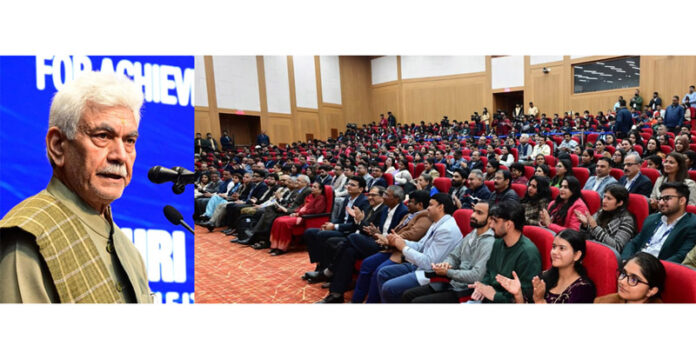

Lieutenant Governor Manoj Sinha announced on Monday that large parts of India have been liberated from terrorism. He noted that most regions in the northeast are now free of this menace. Furthermore, he indicated that local recruitment into terrorist ranks in Jammu and Kashmir has sharply declined, with only a few incidents reported.
During his address at the three-day Strategic Management Forum (SMF) Conference in Jammu, Sinha emphasized the importance of policy-making in achieving the vision for Viksit Bharat by 2047. He stated, “The threat of left-wing extremism and Naxalism has been significantly curtailed.”
“Large parts of the country have been freed from terrorism. Except for a few pockets, most of the northeast has become terrorism-free. The threat of left-wing extremism and Naxalism, which aimed to create a corridor from Hyderabad to Nepal, now remains confined to just two or three districts,” Sinha explained.
Addressing the specific situation in Jammu and Kashmir, Sinha expressed confidence regarding security achievements. “No top commander of terrorist organisations operating in the region is alive today,” he asserted. He also reported a drastic decline in local recruitment, stating, “Hardly one or two youths are being recruited now.”
Despite these advancements, Sinha warned of ongoing challenges posed by infiltrators from Pakistan. “Those coming from across the border are hiding in dense forests and mountainous terrains. I assure you they will be eliminated,” he vowed, emphasizing the determination of security forces.
Sinha also acknowledged a shift in the profile of individuals involved in terrorism. He mentioned that educated individuals are increasingly getting involved in these activities. “The fight against terrorism cannot be left solely to security forces,” he said. He urged societal involvement and the cooperation of administrative bodies in combating terrorism, especially in sensitive regions like Jammu and Kashmir and parts of Karnataka and Kerala.
The Lieutenant Governor highlighted the need to eliminate the divisive “insider-outsider” narrative that hampers development. He argued that such thinking obstructs necessary progress.
Shifting focus to India’s broader development goals, Sinha spoke about the crucial roles of policymakers and business leaders in adjusting to the challenges the nation faces in a rapidly evolving world.
“Our priority should include macroeconomic stability, high investments in education and healthcare, efficient use of digital technologies, and a commitment to transparency and accountability,” he outlined.
He praised the rapid growth witnessed under Prime Minister Narendra Modi’s leadership, asserting that industry leaders now feel a renewed confidence. He noted that sectors such as manufacturing and handicrafts are innovating and competing globally, driven by Modi’s call for Swadeshi.
The economic potential of Jammu and Kashmir drew particular focus in Sinha’s remarks. He called for a greater emphasis on tapping into the region’s vast mining resources, outlining that J&K possesses significant reserves of limestone, sapphire, and lithium.
“With strategic planning, an additional annual revenue of Rs 15,000 crore to Rs 20,000 crore can be generated in the next five to seven years,” he predicted, advocating for enhanced policy frameworks, especially in hydropower and agriculture.
In recognizing the cultural heritage of the region, Sinha inaugurated the Basohli Painting Exhibition and concluded the Basohli Painting Workshop, honoring local artists. “Basohli Painting is our priceless artistic heritage with immense value for present and future generations,” he remarked.
The event saw participation from prominent figures, including Prof B.S. Sahay, Director of IIM Jammu; R.K. Chaudhary, Chairman of JERC J&K and Ladakh; and Shruti Awasthi from the IGNCA, among other academicians, policymakers, and industry leaders.